Opinion
The eclipse of Globalization
In December 2025, I took part in the plenary meeting of the Círculo de Montevideo, joining a panel entitled The Eclipse of Globalization. There, I proposed interpreting the current phase of globalization through the interaction of three major forces: technology, public policy, and geopolitics.
I had adopted this analytical framework a few months earlier, drawing on an insightful study published by the Centre for Economic Policy Research (CEPR) earlier that year: The State of Globalisation, edited by Richard Baldwin and Michele Ruta. The volume brought together contributions from leading economists based on research presented at a conference organized in April 2025 by the International Monetary Fund and the University of Tokyo’s Center for Advanced Research in Finance.
Building on that framework, my contribution was to compare two cycles. The first, beginning with the fall of the Berlin Wall, was characterized by an extraordinary intensification of global integration. The second, which defines the contemporary phase, began with the 2007–2008 financial crisis and is characterized by the growing fragmentation of the world economy.
Trade wars, the proliferation of national standards, and the conditions imposed on investments deemed critical may create the impression that the world is “deglobalizing.” The evidence, however, is far from confirming that hypothesis.
Part of the confusion arises from comparing the present with an exceptional period during which technology, public policy, and geopolitics accelerated in the same direction. A series of financial, commercial, and geopolitical developments subsequently broke that alignment and pushed these forces in divergent directions.
Globalization, therefore, was not disappearing. It was entering a phase of fragmentation caused by the growing divergence among forces that, during the era of hyperglobalization, had operated in extraordinary convergence.
The evidence accumulated since then broadly confirms that diagnosis. It also highlights a phenomenon whose scale was not yet fully apparent: the role of artificial intelligence as a force that simultaneously concentrates strategic capabilities and generates new flows of trade and investment.
A Globalization That Is Reorganizing
The divergence among technology, public policy, and geopolitics has not brought globalization to a halt, but it is changing its geography and the way it operates.
Economic security considerations increasingly influence decisions that were once driven primarily by efficiency. Governments are using tariffs, subsidies, export controls, and investment restrictions to protect strategic sectors. Companies, meanwhile, are diversifying suppliers, building redundant capacity, and reorganizing supply chains to reduce risk.
The result is not a generalized retreat of international trade and investment, but a redirection of their flows. Some economic relationships—particularly those between the United States and China—are weakening, while others are intensifying. Trade within certain regions is growing, as is South–South trade and the role of countries that serve as connectors between the major blocs.
Integration persists, but it is becoming more selective, redundant, and costly. Efficiency is no longer the sole criterion governing the organization of production; it must now coexist with resilience, security, and strategic autonomy.
Recent evidence supports this interpretation. The OECD finds that global value chains remain highly integrated. Rather than repatriating production on a massive scale, companies are diversifying suppliers and redistributing their operations. Reconfiguration, rather than deglobalization, remains the dominant trend.
Research published during 2026 also points to an emerging trading order in which geopolitical competition plays a greater role, but regional and plurilateral arrangements continue to support an international system still largely governed by rules.
Fragmented globalization therefore presents an apparent paradox: it combines political rivalry with economic interdependence, greater restrictions in strategic sectors with new flows of trade and investment, and increasing regionalization with production chains that remain global.
Artificial Intelligence: Concentration and Integration
Artificial intelligence adds a new dimension to this process.
On the one hand, it concentrates economic and strategic power. Advanced semiconductors, computing capacity, data centres, and frontier models are dominated by a limited number of companies and countries. This intensifies competition over critical technologies and helps explain the growing use of subsidies, export controls, and investment restrictions.
On the other hand, that same concentration generates new international flows. The construction of data centres, the production of processors, demand for energy and critical minerals, and the provision of digital services are driving trade and investment across numerous markets.
The WTO estimates that the volume of world merchandise trade grew by 4.6% in 2025—almost twice the rate initially forecast. AI-related goods accounted for close to half of that growth, despite representing only about one-sixth of world merchandise trade.
UNCTAD data for the first half of 2026 point in the same direction. Trade in critical minerals increased by 38%, semiconductors by 25%, batteries by 15%, and information and communications technology products by 14%.
Technology is thus once again playing its dual historical role: integrating and fragmenting at the same time. AI creates new interdependencies and expands international demand, but it also concentrates capabilities that governments consider essential to their security and autonomy.
We are not facing a world economy that is simply dividing into closed blocs. We are facing a more complex structure in which certain technologies and relationships are decoupling, while others are becoming denser and more strategic.
Managing Divergence
The principal challenge remains institutional. The multilateral system built after the Second World War was designed to promote convergence, not to manage a situation in which technology, public policy, and geopolitics are moving rapidly in different directions.
Coordinated adjustment among the major economies would be the most efficient response, but it appears politically unlikely. The relevant question, then, is how the world economy can preserve cooperation in the absence of such coordination.
When universal agreements cannot be reached, open regional agreements and plurilateral arrangements can provide alternative paths forward. It may also be necessary to reconsider whether the consensus rule remains appropriate for every decision taken by organizations such as the WTO.
Voluntary coalitions offer another possibility: allowing countries willing to move faster to do so, while keeping those agreements open to future participants. The objective is not to replace multilateralism with closed blocs, but to introduce different speeds within a common architecture.
The evidence from 2026 reveals fragmentation and resilience at the same time. Some trading relationships are weakening, while others are strengthening. Regional value chains are becoming denser, but they retain global connections. South–South trade is expanding, and artificial intelligence is generating new exchanges even as it intensifies strategic competition.
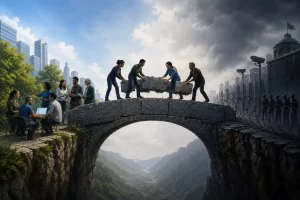
That is why the eclipse remains an appropriate metaphor. Globalization has lost some of the brightness and dynamism it acquired after the Cold War, but it has not disappeared. It is reorganizing.
The question is no longer how to return to the globalization of the past, but how to build rules and institutions capable of managing a world economy in which interdependence coexists with rivalry.
References
Baldwin, Richard, and Michele Ruta, eds. (2025), The State of Globalisation, CEPR Press.
Baldwin, Richard (2026), World War Trade: Conflict, Containment, and the Emergent World Trading Order, CEPR Press.
OECD (2026), Global Value Chain Repositioning.
UN Trade and Development (2026), Global Trade Update, July–August 2026.
World Trade Organization (2026), Global Trade Outlook and Statistics